TB-500 research across cells and tissues
The parent protein does several interesting things. The changes in tissue and outcome make the broad word “repair” feel increasingly inadequate to me.
Actin sequestration
What does TB-500 do? Its sequence carries the actin-binding motif of thymosin beta-4, but the detailed mechanism comes principally from work on the full protein. In the actin-bound structural complex, thymosin beta-4 bound an individual actin unit in a 1:1 relationship, capping both ends and holding it out of filament assembly. The experiment used a gelsolin-domain-1–thymosin beta-4 hybrid bound to actin.
Actin is part of a cell's internal framework. Holding a supply of its separate units affects how that framework can be rearranged, which helps explain the interest in movement and repair. The review connecting actin sequestration to injured-tissue repair brings these roles together. The actin structure is unusually satisfying: it gives the broad regeneration story a concrete molecular action.
How does TB-500 work in a person? That remains unresolved for the isolated fragment. The biochemical explanation is strongest for full-length thymosin beta-4, and applying it to the seven-amino-acid peptide requires experimental confirmation.
Thymosin beta-4 after injury
Full-length thymosin beta-4 occurs in nearly all human cells. Platelets and macrophages release it at injury sites, and the review of its basic properties and clinical applications describes cell migration, blood-vessel formation and anti-scarring activity across experimental models. In cell experiments, the protein also suppressed TNF-α–induced NF-κB activation and IL-8, a mechanistic basis for interest in inflammation.
The parent chain can yield Ac-SDKP, a separate peptide with anti-fibrotic and angiogenic activity. That piece comes from the opposite end of the protein from the TB-500 sequence. The isolated Ac-LKKTETQ fragment cannot supply it. Treating the parent as a collection of interchangeable pieces seems chemically careless to me: which piece is present changes the biological possibilities.
TB-500 benefits in animal research
The TB-500 benefits often discussed for skin have a substantial parent-protein experiment behind them. In rats with full-thickness wounds, topical or intraperitoneal thymosin beta-4 increased re-epithelialization—the return of a skin covering—by 42% at 4 days and up to 61% at 7 days versus saline. Wound contraction increased by at least 11% by day 7, alongside greater collagen deposition and angiogenesis. In keratinocyte migration assays, as little as 10 pg stimulated movement two- to three-fold.
Those are specific observations in rats and cell assays. The dermal-healing review places them in the wider wound literature. Full-length thymosin beta-4 also enhanced medial collateral ligament healing in rats, as summarized in the multi-model review. Human tendon healing, a human recovery timeline and clinical benefit from the TB-500 fragment remain unestablished.
Muscle strength
In dystrophin-deficient mdx mice treated for six months, full-length thymosin beta-4 increased regenerating skeletal-muscle fibers significantly. Muscle strength and systolic cardiac function showed no significant improvement, and skeletal and cardiac fibrosis remained elevated.
The muscle result limits how freely I can use the word repair. More regenerating fibers can coexist with unchanged strength in a disease model. An account of TB-500 for muscle tears or exercise recovery has to accommodate that result alongside the positive wound findings. Controlled human muscle-recovery evidence for the fragment is still missing.
Cardiac and neurological findings
In mice after coronary artery ligation, full-length thymosin beta-4 activated PINCH–ILK–Akt survival signaling, enhanced early cardiac-cell survival and improved cardiac function. That is an encouraging combination of a mechanism and an organ-level result within the mouse model.
The rat embolic-stroke experiment also measured neurological function, finding significant improvement at 2 and 12 mg/kg but no significant benefit at 18 mg/kg. These experiments used the full-length protein in different injury settings. Both findings deserve further investigation. An identical response across organs, amounts or the isolated fragment looks implausibly neat to me. The dose-response discussion stays with that last rat finding.
Hair follicles
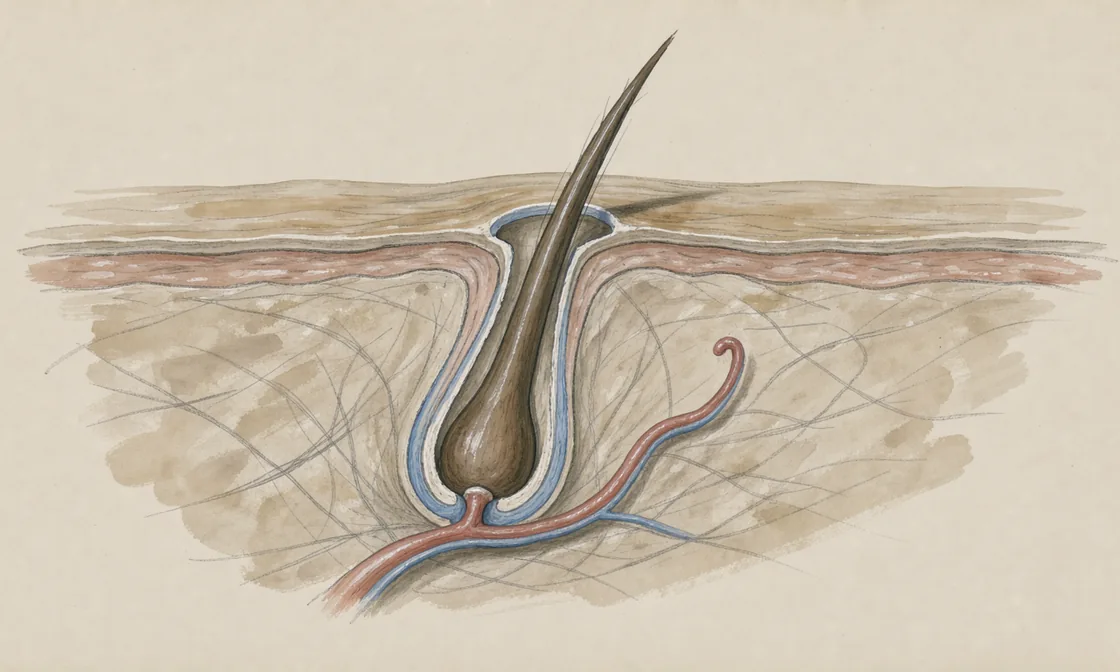
The mouse hair-growth study adds a less obvious strand to the thymosin beta-4 record. A review of follicle growth and development describes the protein's potential roles in follicle biology, while rodent work spanning vessel growth, wounds and hair follicles places hair development beside other tissue effects.
Hair follicles make the breadth of this protein tangible. The interest includes migration and differentiation of follicle stem cells, with nanomolar thymosin beta-4 active in rodent work described in the existing record. The human hair-growth claim awaits its own fragment trial.
TB-500 and BPC-157
TB-500 and BPC-157 appear together in the review of peptide therapies for musculoskeletal injuries and athletic performance. They are distinct molecules: TB-500 is the thymosin beta-4 actin-binding fragment, while BPC-157 is a separate pentadecapeptide. Neither has FDA approval. The review describes favorable animal repair signals and scarce rigorous human safety data for unapproved peptides.
There is no controlled trial of the pair used together in this record. Combining names on a recovery list supplies no evidence of synergy. I want an attributable response from each compound before assigning an effect to a combination. A combination would need its own experiment.